


What Is Trauma-Informed Science & Care?
Welcome to Trauma-Informed Thoughts, a space where we explore the ways trauma shapes our lives—and how we can respond with care, understanding, and science-backed strategies. Whether you’re a healthcare worker, educator, community leader, or someone just curious about how trauma impacts people, this blog is here to offer insights and practical guidance.
But Trauma-Informed Thoughts isn’t just about professional settings or clinical discussions. It’s about applying a Trauma-Informed lens to any topic—from mental health and education to social issues, politics, and human behavior in general. The goal?
To invite curiosity and conversation about how trauma intersects with the world around us and how a Trauma Informed perspective can bring new possibilities.
So before we dive into specific topics, let’s start with the basics: What is Trauma-Informed science, and what does it mean to provide Trauma-Informed care?
Trauma-Informed Science: Understanding the Why
Trauma-informed science explores how trauma—especially repeated, prolonged, or early-life trauma—shapes the brain, body, and behavior. Research from psychology, neuroscience, and social work reveals that trauma can alter how a person processes stress, relationships, and their sense of safety in the world. At its core, this science shows that a person’s internal experience of themselves forms the foundation for how their neurobiology adapts.
Some key takeaways from trauma-informed science:
✅ Trauma is more common than we think. The Adverse Childhood Experiences (ACEs) study found that early trauma is linked to long-term health, emotional, and social challenges. Looking at how many people struggle, reality shows us this every day.
✅ Trauma rewires the brain. Stress responses like fight, flight, freeze,dissociate and fawn can become automatic patterns. This isn’t a choice—it’s the body’s way of protecting itself.
✅ Healing is possible. The brain and body can rewire with the right supports, including safe relationships, therapeutic interventions, and community care. A neurobiological system stuck in survival needs the experience of safety to move towards more freedom and change.
Trauma-Informed Care: The How
Trauma-informed science explores how trauma—especially repeated, prolonged, or early-life trauma—shapes the brain, body, behavior and self-perception. Research reveals that trauma can alter how a person processes stress, relationships, and their sense of safety in the world. Rather than asking, “What’s wrong with you?” or even “What happened to you?”, a more trauma-informed question is:
“How did your neurobiological system have to adapt to what it experienced?”
This shift moves the focus away from the details of the story— which can be re-traumatizing—and instead acknowledges the body and brain’s survival responses. It recognizes that behaviors, emotions, and patterns that might seem “dysfunctional” are often deeply intelligent adaptations to past experiences.
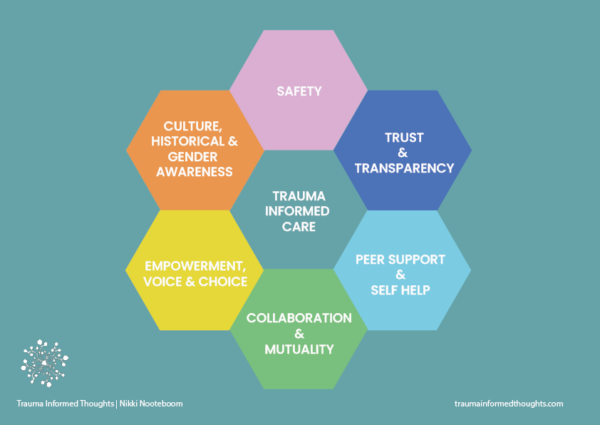
The 6 Core Principles of Trauma-Informed Care
- Safety – Physical and emotional safety are the foundation of healing.
- Trust & Transparency – Clear communication and reliability build trust.
- Peer Support & Self-Help – Connecting with others who understand can be powerful.
- Collaboration & Mutuality – Healing isn’t one-sided; it’s a shared process.
- Empowerment, Voice & Choice – People need to feel in control of their own healing.
- Cultural, Historical & Gender Awareness – Acknowledge systemic trauma and create inclusive spaces.
Why Trauma-Informed Care Matters
When we integrate trauma-informed care into our work, relationships, and systems, we create spaces where people feel safe, heard, and respected. It’s not about “fixing” people—it’s about understanding, supporting, and providing tools for healing.
This blog will explore different aspects of trauma-informed care, but it will also ask bigger questions:
👉 How does trauma impact leadership and decision-making?
👉 How do historical and cultural traumas shape societies today?
👉 How can we bring more empathy and awareness into everyday conversations?
Our Thoughts’ Goal
These Thoughts aren’t about having all the answers—it’s about getting curious. Together, let’s challenge assumptions, explore different perspectives, and build a world where compassion and science work together to support healing.
Welcome to Trauma-Informed Thoughts.
Other interesting Thoughts
When you do, please know that we only use your details for this purpose, you can unsubscribe at any time!
You're a genuine Trauma Informed professional? Write for this brand new platform!

Inspired? Make a donation so we can keep bringing new perspectives!