

Emotions, thoughts and the midbrain
It’s often assumed that healing from trauma means you need to understand your emotions, fully feel them, explain the content of your thoughts, and process all of it. It sounds logical: when your inner world feels intense and chaotic, you want to know what it is and why it’s there. But that intensity doesn’t come from limbic emotions or cortical analysis. Those come later. They react to a survival brain that autonomously and chronically orients toward danger, activates a survival sequence the moment a trigger appears, and in doing so blocks access to presence and reflection. That’s why you keep ending up in the same panic cycle and trauma loop.
Midbrain / survival brain
In a traumatized brain, the midbrain is almost constantly in a state of vigilance, usually developed out of necessity within unsafe attachment relationships. It determines whether you are safe enough to stay present or whether danger is approaching and you need to act. As soon as something is interpreted as threat — and with trauma this happens extremely quickly — it narrows orientation directly toward the perceived source of danger. That might be an actual situation, but just as often a (bodily) memory activated through a trigger.
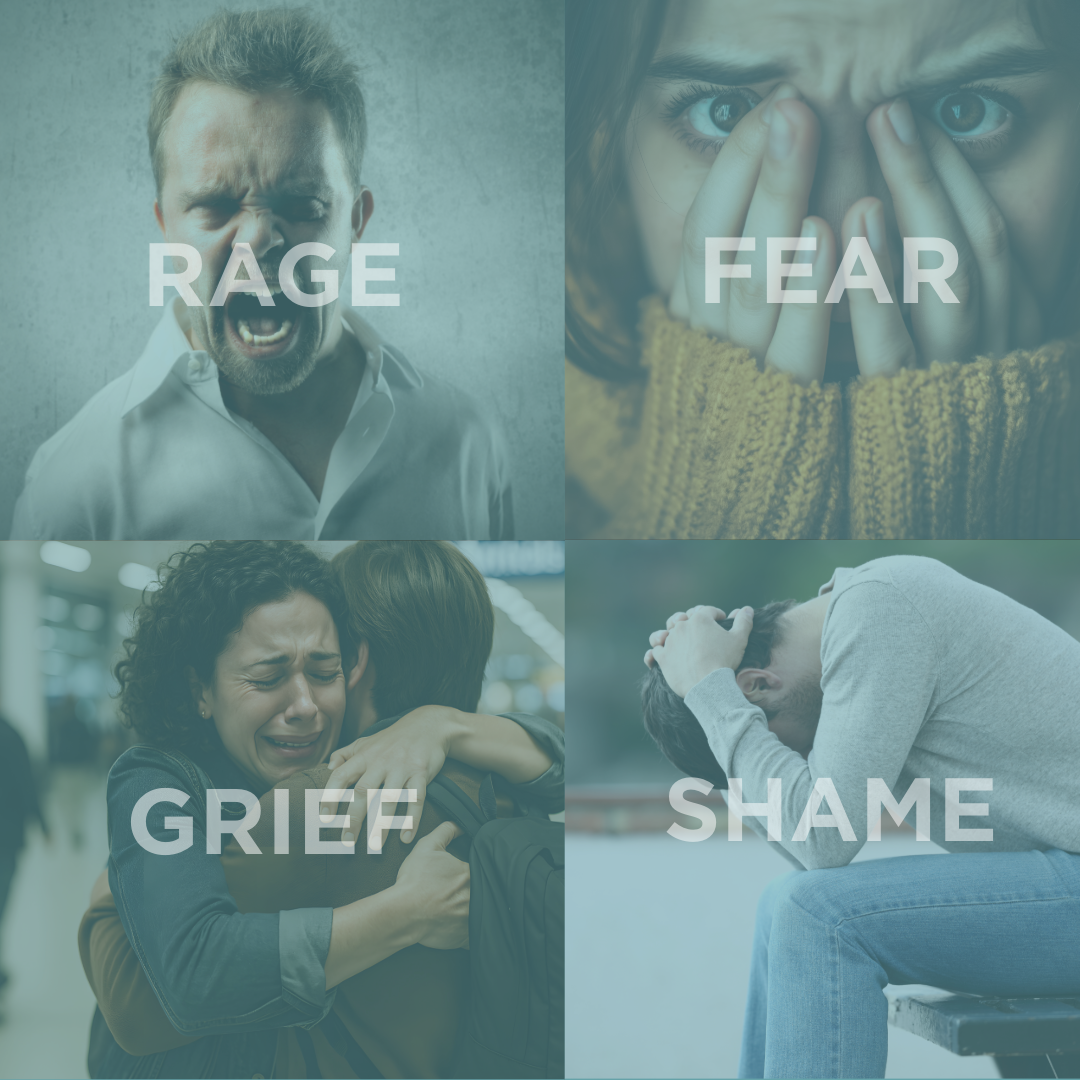
The first “emotional” reaction to a trigger does not arise in the limbic system, but in the midbrain. This is where autonomous affect states emerge — not psychological emotions, but raw survival reactions: rage, fear, grief, and shame. You cannot choose them, and you cannot control or regulate them with thinking. The limbic system and cortex respond afterwards, reacting to what the survival brain has already set in motion.
In the neuroscience-based therapeutic model known as Deep Brain Reorienting, this is called the OTAS cascade: orientation toward danger → tension → autonomous affect states → survival behaviour → seeking the familiar negative survival state. From there, sensations, emotions, and thoughts keep repeating themselves. Limbic and cortical reactions feed back into this loop as well.
Reactivity of thoughts and emotions
Thoughts and emotions are secondary reactions to the inability to escape that narrowed orientation. So the question becomes: if regulating, talking, or understanding can’t break this cycle, what can? Thanks to researchers such as Ruth Lanius, Dan Siegel, and Frank Corrigan, we now better understand what a traumatized brain does (detect threat and activate survival states) and what it cannot do (recognize the present moment and differentiate you from your environment). The entry point is therefore not in the content, but in the midbrain where the cascade begins.
In Neuro-Informed therapy, we first strengthen the part of the brain that can bring you back to the present and keep you there — the vestibular system. From there, we work at the beginning of the cascade: the moment orientation narrows, tension — especially in the neck — builds, and a shock response is triggered. This is the origin of the fear, anger, shame, or grief that can escalate within seconds and drive autonomous survival behaviour. The result is often days of emotional and cognitive loops, a hyperfocus on one perceived problem, and little to no space for anything or anyone else.
Misinterpretation as denial
For many people, this way of working can feel as if their experience is being dismissed. They live daily with the emotions, thoughts, and chaos, so the idea that therapy does not start there can feel like rejection. But this approach does not try to remove or deny anything; it prevents the reactions from being recreated over and over again by addressing the midbrain before the survival chain activates. We work before escalation, so the system can stay integrated and the survival brain doesn’t need to take over.
Back to the beginning
Emotions and thoughts do play a role in this therapy — they mainly show how powerless you feel in relation to the autonomous activation. We simply don’t use them as material to analyse. We start with stabilization and then gradually regulate the narrowed orientation and the tension activated in the midbrain, because that is where the whole survival cascade begins. From there, the rest of the chain — especially the affect — can be processed without the system returning to survival.
And consider this: when you feel safe, present, and okay, do you have the same emotions and thoughts as when you feel afraid? Exactly. That’s why we don’t start with emotion or thought, but with the state that drives them. It’s a very different way of working, which may feel unusual at first — and where your therapist will guide you. It creates an organization toward safety instead of toward danger.
Other interesting Thoughts
When you do, please know that we only use your details for this purpose, you can unsubscribe at any time!
You're a genuine Trauma Informed professional? Write for this brand new platform!

Inspired? Make a donation so we can keep bringing new perspectives!